
Hidden histories. A 9-minute read, best with a smoky Lapsang Souchong.
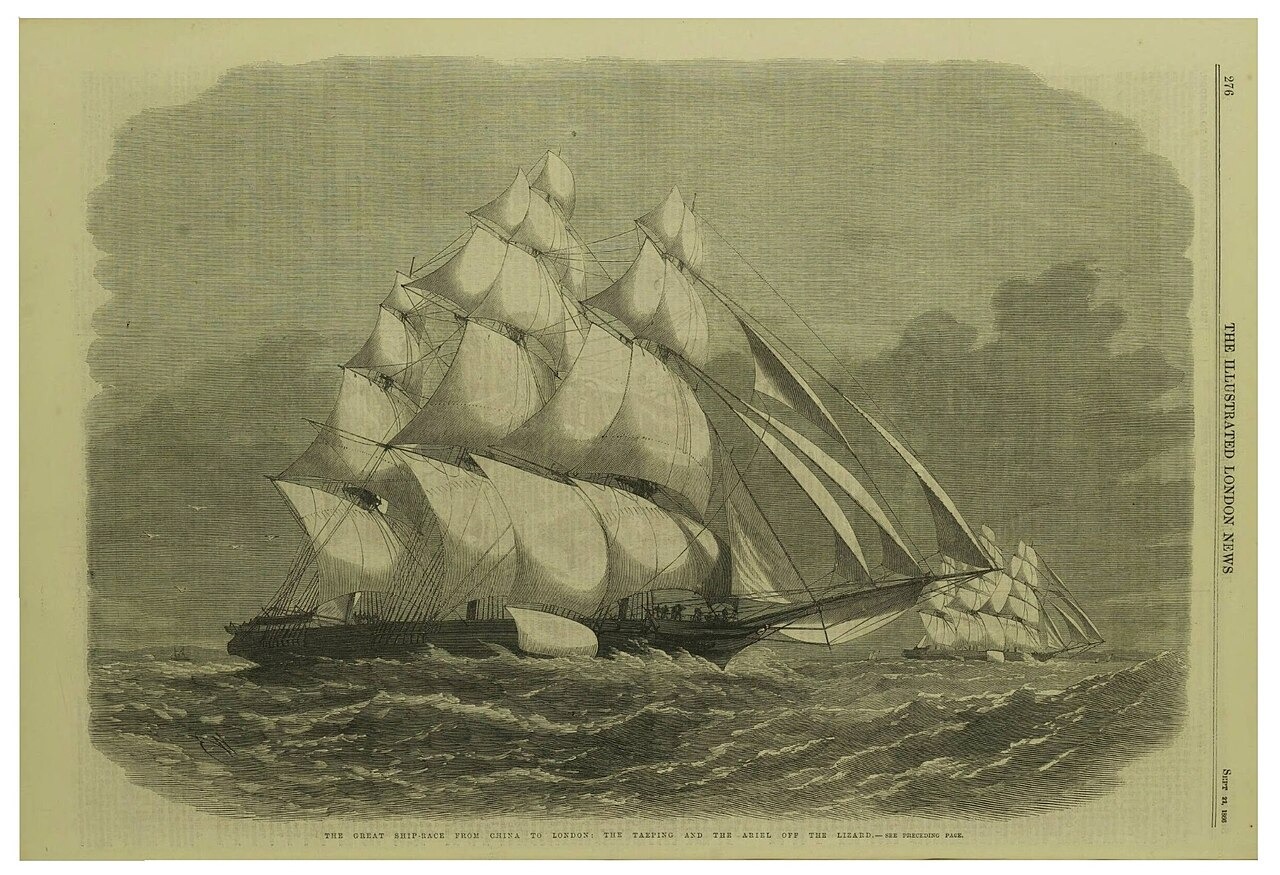
Every spring in the mid-1800s, the finest new tea of the season waited on the quays of Fuzhou, in China’s Fujian province. Whoever landed it first in London could command a premium, and so the fastest sailing ships in the world, the tea clippers, raced each other halfway around the globe to get it there.
The start
In May 1866, sixteen of the best clippers gathered at the Pagoda Anchorage on the Min River, downstream from Fuzhou. Tea chests were floated out and packed into their holds. On 28 May, the Ariel, under Captain John Keay, weighed anchor first, but her tug could not get her across the river bar on a falling tide. By the next morning two rivals had caught up with her: the Taeping, under Captain Donald MacKinnon, and the Serica. The race was on.
Fourteen thousand miles
For more than three months the ships crossed the South China Sea, the Indian Ocean, rounded the Cape of Good Hope and beat north up the Atlantic, often out of sight of each other for weeks. Then, astonishingly, Ariel and Taeping met again near the English coast and raced within sight of each other up the Channel and into the Thames.
On 6 September 1866, after 99 days at sea, Taeping docked in London just under half an hour ahead of Ariel, which had been in front off the Kent coast but drew more water and had to wait for the tide to enter her dock. Serica docked shortly after. Three ships that left China on the same tide had arrived in London on the same tide, less than two hours apart. The owners agreed to share the prize.
Ninety-nine days, fourteen thousand miles, and a finish decided by the height of the tide.
The end of an era
The newspapers adored it, but the race also hinted at what was coming. A steamship, the Erl King, had left Fuzhou a week after the clippers and reached London about two weeks before them. The Suez Canal opened in 1869, and the age of sail in the tea trade quickly faded. Ariel herself was lost at sea a few years later, on a voyage to Sydney in 1872.
You can still see the spirit of those ships today in the Cutty Sark, the clipper preserved at Greenwich in London.
Pour it like a sailor
The great clippers carried Chinese teas, many from Fujian, home to the smoky, pine-scented Lapsang Souchong. Brew a pot, lower the lights, and imagine the spray off the bow.
Engraving: Edwin Weedon, 1866, public domain, via Wikimedia Commons. Sources include contemporary accounts summarised by the Smithsonian Magazine and Wikipedia.